
108-108 in Moncton: USA Take an 11th NORCECA Crown, Cuba Claim the Last Ticket
**Câu trả lời cốt lõi**: Mỹ thắng Canada 3-2 (25-19, 26-24, 25-27, 17-25, 15-13) trong trận chung kết bóng chuyền nam NORCECA tại Moncton, New Brunswick, Canada. Hai đội bằng nhau tuyệt đối về tổng điểm: 108-108. Cuba thắng Cộng hòa Dominica 3-0 và lấy suất cuối cùng dự sự kiện thế giới 2027. **Dữ kiện chính**: - Tổng điểm trận chung kết: Mỹ 108 – Canada 108; set năm kết thúc 15-13. - Mỹ giành chức vô địch châu lục lần thứ 11. - Matt Anderson (Mỹ) 18 điểm: 17 tấn công, 1 phát bóng. - Jake Hanes (Mỹ) 18 điểm: 15 tấn công, 2 chắn bóng, 1 phát bóng. - Xander Ketrzynski (Canada) 26 điểm: 25 tấn công, 1 chắn bóng. - Cuba thắng Cộng hòa Dominica 3-0: 25-22, 25-19, 26-24. **Nguồn**: Tổng hợp báo cáo kết quả giải vô địch châu lục NORCECA nam tại Moncton, Canada. Các chỉ số cá nhân chưa được đối chiếu biên bản kỹ thuật chính thức; tên giải đích năm 2027 cần kiểm chứng | Cross-checked: VuaBong.vn **Hỏi đáp liên quan**: **Hỏi**: Vì sao tổng điểm 108-108 lại quan trọng? **Đáp**: Vì trận đấu kết thúc ngang bằng tuyệt đối, nên chức vô địch được quyết định bởi hai điểm tiebreak chứ không phải bởi sự vượt trội về hiệu suất. **Hỏi**: Vì sao suất dự năm 2027 được gọi là "World Cup"? **Đáp**: Nhiều khả năng đây là cách gọi sai, vì FIVB đã chấm dứt giải World Cup sau kỳ 2019 và chuyển sang Giải vô địch thế giới theo chu kỳ hai năm. **Hỏi**: Điểm yếu cấu trúc rõ nhất của Canada là gì? **Đáp**: Tải trọng dứt điểm tập trung vào một đối chuyền, thể hiện qua 26 trong 108 điểm của đội đến từ một mình Ketrzynski.
108-108 in Moncton: USA Take an 11th NORCECA Crown, Cuba Claim the Last Ticket
The last two points, in an empty arena
The replay I watched had no commentary. Only the squeak of rubber on the floor, the thud of the ball into forearms, and the whistle echoing through a gymnasium in Moncton — a small city in New Brunswick, on Canada's east coast — where the stands were empty enough that every touch sounded like a training session. The fifth set reached 13-13, and the last two points split the outcome: 15-13.
What held me at the screen was not those two points. It was the match total. USA 108, Canada 108. Five sets, 216 points, and when the referee's whistle ended it, the two teams stood level at the exact starting line. The 11th continental title in USA men's volleyball history was decided by a two-point margin after more than two hundred touches.
An arena without spectators, and yet the applause stays in the chest. I have kept that line in my notebook since the afternoons of 2026, when the Vietnamese women's national league was suspended for months and I sat alone on the Hang Day stands, counting Tuyet Dung's serves with nobody clapping. Five years later, on another continent, men's volleyball is playing its decisive matches in a comparable silence. Where there is no crowd, people still play it out — and that does not change with gender or with the level of the tournament.
Context: three tickets, and a bronze-medal match that mattered more
The event took place in Moncton and takes the shape of a continental championship under NORCECA — the North, Central America and Caribbean Volleyball Confederation. The format allocated a limited number of berths to a world-level event in 2027, and by the phrasing used in the result reports, that number was three.
The critical detail is this: before the gold-medal match was played, both USA and Canada had already confirmed their places at the 2027 event. Their berths were secured in advance, which means the final was played with qualification pressure removed from both sides. Most summary reports skip this, because a headline reading "qualify" sounds better than one reading "had already qualified."
The bronze-medal match between Cuba and the Dominican Republic, by contrast, carried the last remaining berth. Cuba won it 3-0, with set scores of 25-22, 25-19 and 26-24. It was played only a few hours before the final — a common arrangement at continental championships, where the third-place match serves as a curtain-raiser.
I once followed a continental youth tournament the same way: sitting with a notebook through every set, then realising that the order of play determines which team is genuinely tested and which team is merely playing for pride. In Moncton, the genuine pressure sat in the match that got the least attention.
The structure of the event says something else as well: the three berths were allocated by continental-championship results rather than by world ranking alone. That turns every knockout fixture into a binary event — win and you travel, lose and you stay home. For Cuba, the match against the Dominican Republic was the single most important fixture of their four-year cycle.
Core analysis: two attacking models, one perfectly level match
The scoreboard of the final, read in sequence: 25-19, 26-24, 25-27, 17-25, 15-13.
The shape of the match is therefore very clear: USA controlled the opening set by six points, took the second by two at the close, lost the third narrowly, collapsed in the fourth by eight, then steadied in the fifth by two. A fourteen-point swing between set one and set four is a strong signal that Canada found a way to read the match after falling 0-2 behind.
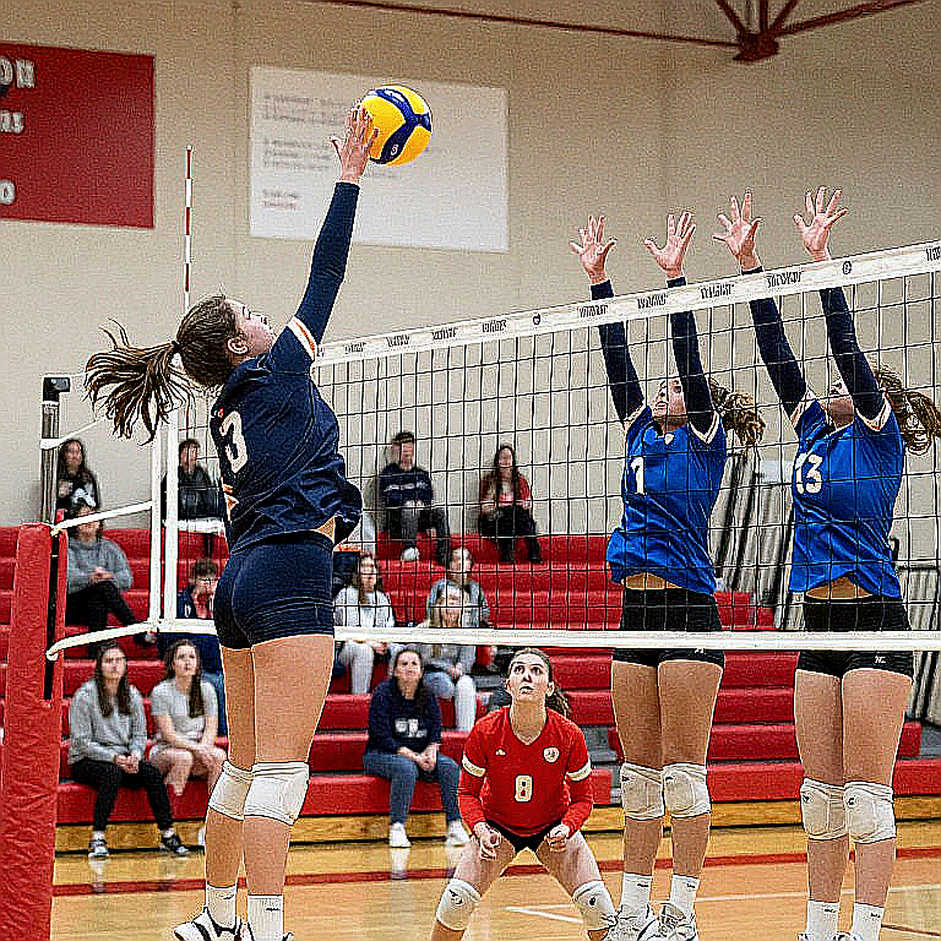
On the individual side, the picture is sharper still.
Matt Anderson, a veteran outside with an Olympic medal behind him, scored 17 attacking points and 1 service point, 18 in total. Jake Hanes, an up-and-coming opposite, scored 15 attacking points, 2 blocking points and 1 service point, also 18 in total. Together, those two attackers accounted for 36 of USA's 108 points — roughly 33.3%.
On Canada's side, Xander Ketrzynski scored 25 attacking points and 1 blocking point, 26 in total. Of Canada's 108 points, he accounted for about 24.1%, and almost all of it came from the attack. He was the match's leading scorer, eight points clear of either of USA's top two — and his team lost.
Two structurally different attacking paths. USA spread the terminal load across two pins; Canada placed almost its entire output on a single opposite. That does not automatically mean USA was better as a system, because the compiled data I have in hand lists only the scorers; it does not give starting line-ups, setter distribution, or middle-blocker involvement. But the structure is visible: one team had two destinations, the other had one.
The tactical consequence is concrete. When a single outlet accounts for nearly a quarter of a team's total points, the opposing block and back court can read the game through one player. At continental level that may still be enough to win the earlier rounds. At world level, where middle blockers are deeper and quicker, it becomes an exploitable script.
But the real story of this match lies elsewhere, and it lies in a gap.
The data gap around this final is large enough that nobody's attacking quality can actually be assessed. There are no attempt counts, no success rates, no efficiency figures, no attacking errors, no times blocked. Ketrzynski scored 25 attacking points — but from how many attempts? From 40, and it was an extraordinary evening. From 60, and it was a high-volume, average-efficiency one. Without a denominator, those two possibilities cannot be told apart. At the same time, the total service points in the match amounted to two: one from Anderson, one from Hanes. Service errors were not reported. Not a single block, dig or reception figure appears anywhere in the compiled record.
In other words, roughly two-thirds of a standard technical box score is missing. What remains is enough to reconstruct the result and to identify one structural pattern. It is not enough to conclude which team attacked better.
One small detail stands out on the American side. Jake Hanes, an opposite, recorded 2 blocks across five sets. For that position, participating in the block at positions 2 and 4 is a positive individual signal, even though two blocks in five sets is a very modest rate against the benchmark set by middle blockers. And the fact that an up-and-coming opposite was run through the full five sets of a continental final, rather than protected by a substitution, was a deliberate choice by the coaching staff.
On Cuba's side, the 3-0 needs to be read correctly too. The three-set aggregate was 76-65 in Cuba's favour, but set one finished 25-22 and set three finished 26-24. Two of the three sets were settled inside the final four points. Cuba's berth came not from dominance but from the ability to close sets at the decisive moments. That is a different capability, and a more fragile one.
The counter-intuitive angle
There is a naming problem I cannot pass over, because it shapes how a reader values the entire event.
The reports call these berths places at the "2027 World Cup." FIVB discontinued the event bearing the name World Cup after the 2026 edition. The flagship senior national-team event is now staged on a two-year cycle — 2026, 2027 — under the name World Championship. The qualification mechanism described here — a continental championship allocating berths to a world-level event — matches the qualification model of the World Championship. It matches no surviving "World Cup." The most probable reading is that the destination event has been mislabelled in the course of the story travelling.
This is not a trivial detail. It changes the prestige of the event, the ranking-point weighting, and the preparation logic of the federations involved. A reader who takes this as World Cup qualification will draw the wrong conclusion about what each match was worth.
Alongside that, there is a larger paradox in how the story is told. USA's and Canada's berths were already secured before the final. The only berth still live was in the bronze-medal match. The fixture with the highest competitive consequence was the one told most briefly. The match described as "nerve-wracking" was the one with nothing left to lose.
And then there is the problem of individual statistics. Over the years I have learned that an aggregate figure can be simultaneously accurate and misleading. An opposite scoring 26 points in a defeat is an indicator of workload, not of efficiency. It resembles those distance-covered tables: running a lot can be a sign of effort, or a sign of running in the wrong direction, and the table cannot distinguish between them without context.
At the same time, an underrated story sits right there in the American box score. Anderson, at the closing end of a peak career, and Hanes, at its beginning, each scored 18 points in a final. That symmetry suggests a deliberate load-sharing rather than a coincidence of form — and it is the most forward-looking datum of the whole match, even though it has no place in the headline.
Canada, in the other direction, leaves this fixture with an undervalued profile. They lost a five-set final by two points in the tiebreak while matching the champions on aggregate across 216 points and producing the match's leading scorer. That is not the image of a weaker team.
It is worth remembering that North American men's volleyball has no domestic professional league strong enough to anchor elite development. Both USA and Canada depend on European clubs and, in the American case, on the college system, to maintain and develop top-level attackers. The consequence is that the number of players carrying a dense international load is compressed into a small group, and federations must negotiate with clubs for assembly time — a negotiation in which the clubs always hold the stronger hand. For Cuba the structural question is more sensitive still: the region's deepest talent pool, tied to a long history of elite players competing abroad, which makes availability during national-team windows a permanent variable.
There is another market dimension I tend to think about when reading tables like these. In a transfer window, noise always outruns signal. A 26-point evening in a defeat can quickly become a repriced profile, and agents understand better than anyone how to turn a statistic without a denominator into a negotiating advantage. I have no evidence that this happened here. But I do know that the transfer market does not wait for complete data before it sets a price.
What comes next
Cuba has its berth. USA has its berth and its 11th title. Canada has no title, but has lost no standing.
For Cuba, this ticket may be the single largest resource conversion of their four-year cycle. For USA, hosting the 2028 Olympics while holding a rising opposite is a favourable configuration — provided the succession is completed before Anderson stops. For Canada, the only question worth asking is not about form but about architecture: when does a second player arrive to carry the closing share of the attacking load?
A dream does not need a ticket, but it needs someone willing to tell the story. The match in Moncton ended in a nearly empty arena. Two teams shared 216 points and one trophy. Three berths were handed out. And most of us will not remember the name of anyone involved in a few months — unless somebody sits down, rewinds the tape, and counts it all the way through.